
What Is Hydrogen Water?
Hydrogen water has emerged as a topic of interest in health, wellness, and nutritional science, often promoted for its potential antioxidant properties and role in supporting normal cellular processes. Despite this growing interest, many individuals remain uncertain about what hydrogen water actually is, how it differs from regular drinking water, and what science currently supports about its use.
At its simplest, hydrogen water is ordinary water into which molecular hydrogen gas (H₂) has been dissolved. Unlike regular water (H₂O), which already contains hydrogen as part of its molecular structure, hydrogen water contains additional free molecular hydrogen that is not chemically bonded to oxygen. These free hydrogen molecules are proposed to interact within the body differently from the hydrogen already bound within the water molecule itself. Optimal Health+1
Molecular hydrogen is colourless, odourless, and tasteless, and when it is dissolved in water it behaves as a neutral gas rather than a chemical compound. Early scientific inquiry suggests that the presence of dissolved hydrogen may support antioxidant mechanisms at a cellular level, though research remains preliminary and further clinical evidence is needed to fully understand its long-term impacts. MDPI+1
This article explains what hydrogen water is, how it is produced, what current research says about its physiological effects, and how it compares to regular water, while maintaining a clear boundary between evidence-based science and marketing claims.
What Exactly Is Hydrogen Water?
Hydrogen water is water that contains dissolved molecular hydrogen gas (H₂). In practical terms, it is regular drinking water (H₂O) with additional free hydrogen molecules infused into it.
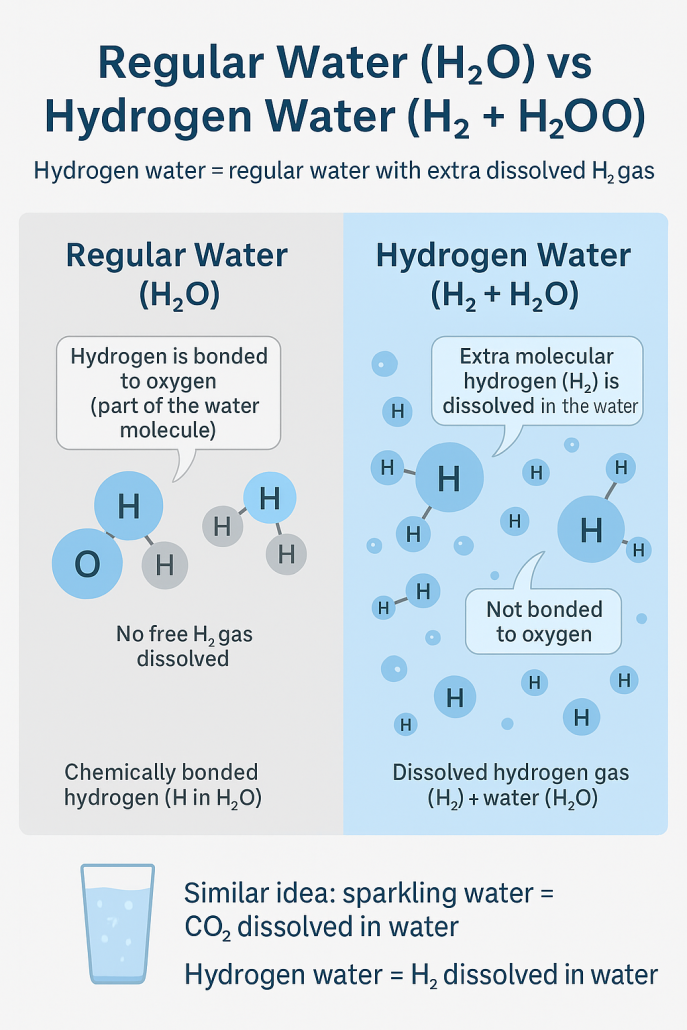
This distinction matters because the hydrogen already present in water (H₂O) is chemically bonded to oxygen and does not behave the same way as dissolved molecular hydrogen (H₂). In hydrogen water, the extra hydrogen is not bonded into the water molecule; it is present as a dissolved gas, similar in concept to how carbon dioxide is dissolved in sparkling water.
A concise definition from the U.S. National Cancer Institute’s Drug Dictionary describes hydrogen-rich water as water in which “the molecular hydrogen gas is dissolved in the water.” Cancer.gov
Scientific interest in hydrogen water is primarily tied to molecular hydrogen (H₂) as a potential selective antioxidant in biological systems. Reviews in the medical literature note that research into molecular hydrogen accelerated after findings in 2007 suggesting it may selectively reduce certain highly reactive oxidants. PubMed Central+1
To keep expectations grounded: credible consumer health references also emphasise that research on hydrogen water’s health benefits remains limited, and more high-quality human studies are needed. WebMD
Key takeaway: When people ask, “What is hydrogen water?” the most accurate answer is that it is water infused with molecular hydrogen (H₂)—and any proposed wellness value relates to the properties of molecular hydrogen, not the basic chemistry of water itself. PubMed Central+1
How Is Hydrogen Water Made?
Hydrogen water can be produced in several ways, but all methods share the same objective: to dissolve molecular hydrogen gas (H₂) into water at a measurable concentration. The effectiveness of each method largely depends on how efficiently hydrogen is generated and how well it is retained before consumption.
Electrolysis (Hydrogen-Generating Water Systems)
One of the most established and widely studied methods of producing hydrogen water is electrolysis.
Electrolysis uses an electrical current to split water into hydrogen and oxygen gases. In hydrogen water systems, the hydrogen gas is dissolved back into the drinking water, while oxygen is separated and released. According to reviews published in Medical Gas Research, electrolysis-based systems are capable of producing hydrogen-rich water in a controlled and repeatable manner, making them suitable for both research and consumer use.
https://www.ncbi.nlm.nih.gov/pmc/articles/PMC3655124/
Advanced electrolysis water systems are designed to:
- Generate molecular hydrogen on demand
- Reduce hydrogen loss before consumption
- Produce hydrogen-rich water without chemical additives
This on-demand approach matters because hydrogen is highly volatile and begins escaping from water immediately after production. Freshly generated hydrogen water therefore retains higher hydrogen concentrations than water stored for extended periods.
For this reason, many people choose to experience hydrogen water directly at home rather than relying on bottled alternatives. Short-term home trials—such as a 30-day Kangen® Water trial—allow individuals to consume freshly produced hydrogen-rich water consistently and assess how it fits into their daily hydration routine.
Hydrogen Tablets
Hydrogen tablets are another method of producing hydrogen water. These tablets typically contain metallic magnesium or other reactive compounds that release hydrogen gas when dissolved in water.
While studies confirm that hydrogen tablets can increase dissolved hydrogen levels, reputable health sources note several limitations:
- Hydrogen concentration varies widely by brand
- By-products such as magnesium hydroxide may alter taste or mineral balance
- Hydrogen levels peak briefly and then decline
A review published in Nutrients highlights that hydrogen delivery methods differ significantly in stability and reliability, which can influence study outcomes and user experience.
https://www.mdpi.com/2072-6643/12/5/1369
Bottled Hydrogen Water
Pre-bottled hydrogen water is also available commercially, but hydrogen retention remains a key challenge.
Because molecular hydrogen is extremely small, it can escape through plastic and even some metal containers over time. Research has shown that hydrogen concentration in bottled water can decline substantially during storage, transport, and exposure to heat. Source: https://www.ncbi.nlm.nih.gov/pmc/articles/PMC7019778/
As a result, bottled hydrogen water may contain significantly less hydrogen by the time it is consumed, even if it was hydrogen-rich at the point of bottling.
Why Freshness Matters
Across scientific literature, one principle is consistent: hydrogen water is most effective when consumed fresh.
Medical researchers note that freshly generated hydrogen water:
- Retains higher hydrogen concentrations
- Provides more consistent dosing
- Avoids degradation during storage
This explains why electrolysis-based systems that generate hydrogen water on demand are commonly used in both research settings and long-term personal use.
In summary, hydrogen water can be produced through multiple methods, but fresh, on-demand generation remains the most reliable way to ensure meaningful hydrogen levels. Experiencing hydrogen-rich water freshly produced at home—such as through a limited-time home trial—allows individuals to evaluate its taste, quality, and role in daily hydration without long-term commitment.
What Is Molecular Hydrogen (H₂)?
Molecular hydrogen (H₂) is a naturally occurring, diatomic gas made up of two hydrogen atoms. It is the smallest and lightest molecule in the universe, a property that underpins much of the scientific interest in hydrogen water.
In the context of hydrogen water, molecular hydrogen is not chemically bound to oxygen, minerals, or other compounds. Instead, it exists as a dissolved gas that can move freely once ingested.
Key Properties of Molecular Hydrogen
Scientific literature highlights several characteristics of molecular hydrogen that differentiate it from conventional antioxidants:
- Extremely small molecular size, allowing rapid diffusion
- Neutral electrical charge, meaning it does not disrupt normal cellular signalling
- High permeability, enabling it to pass through cell membranes, the blood–brain barrier, and mitochondria
A landmark paper published in Nature Medicine first reported that molecular hydrogen may selectively reduce highly reactive oxygen species, particularly hydroxyl radicals, without affecting other reactive molecules that play useful roles in cell signalling.
https://www.nature.com/articles/nm1577
This selectivity is important. Unlike broad-spectrum antioxidants (such as high-dose vitamin supplements), molecular hydrogen appears to act only on the most damaging free radicals, rather than indiscriminately neutralising all reactive species. Subsequent reviews have reinforced this mechanism as a key reason hydrogen continues to be studied.
https://www.ncbi.nlm.nih.gov/pmc/articles/PMC3655124/
Molecular Hydrogen vs Hydrogen Peroxide
A common point of confusion is the difference between molecular hydrogen (H₂) and hydrogen peroxide (H₂O₂).
They are fundamentally different substances:
- Molecular hydrogen (H₂) is a stable, non-toxic gas
- Hydrogen peroxide (H₂O₂) is a reactive oxidising agent commonly used as a disinfectant
Medical and biochemical reviews consistently emphasise that molecular hydrogen is biologically inert at low concentrations and does not exhibit the damaging oxidative effects associated with hydrogen peroxide.
Naturally Produced in the Human Body
Interestingly, molecular hydrogen is already produced within the human body.
Gut bacteria generate hydrogen gas as a by-product of carbohydrate fermentation. This endogenous hydrogen is absorbed into the bloodstream and eventually exhaled through the lungs. The fact that hydrogen is naturally present in human physiology further supports its safety profile when consumed in low concentrations through hydrogen-rich water.
https://www.ncbi.nlm.nih.gov/pmc/articles/PMC2753952/
Why Molecular Hydrogen Is Added to Water
Water serves as a practical delivery medium for molecular hydrogen because:
- It allows hydrogen to be consumed conveniently throughout the day
- It avoids the need for inhalation or specialised medical equipment
- It integrates easily into existing hydration habits
When produced using on-demand electrolysis systems, hydrogen-rich water provides a fresh and accessible way to introduce molecular hydrogen into daily routines. This practicality is one reason many individuals choose to experience hydrogen water firsthand through short-term home trials before deciding whether it fits their lifestyle.
In summary, molecular hydrogen (H₂) is scientifically distinct from both ordinary hydrogen in water and from common antioxidants. Its small size, selective behaviour, and natural presence in the human body explain why hydrogen water continues to attract serious research interest rather than being dismissed as a passing wellness trend.
How Is Hydrogen Water Different from Alkaline Water?
Hydrogen water and alkaline water are often discussed together, which has led to confusion. While both may be produced using similar water ionisation systems, they are defined by different characteristics and should not be used interchangeably.
| Aspect | Hydrogen Water | Alkaline Water |
|---|---|---|
| Primary defining feature | Contains dissolved molecular hydrogen gas (H₂) | Defined by higher pH (alkaline) |
| Chemical composition | H₂O with additional free H₂ gas dissolved | H₂O with altered mineral content affecting pH |
| Role of hydrogen | Focuses on molecular hydrogen as a dissolved gas | Hydrogen is only part of the water molecule (H₂O) |
| pH level | Can be neutral, slightly alkaline, or alkaline | Typically pH 8–10 |
| Main area of scientific research | Oxidative stress and antioxidant mechanisms | Acid–base balance and hydration |
| Mechanism studied | Selective interaction with certain free radicals | Neutralisation of acidity (theoretical) |
| Dependence on pH | Independent of pH | Entirely dependent on pH |
| Hydrogen bonding | Extra hydrogen exists as free H₂ gas, not bonded to oxygen | Hydrogen remains chemically bonded to oxygen |
| Typical production method | Electrolysis, hydrogen infusion, or tablets | Mineral infusion or electrolysis |
| Stability over time | Hydrogen dissipates quickly; best consumed fresh | pH remains relatively stable |
| Taste | Similar to clean filtered water | May taste slightly smoother or “softer” to some |
| Common misconception | Often confused with alkaline water | Often assumed to provide hydrogen benefits |
| Scientific consensus | Emerging research; supportive, not therapeutic | Limited clinical evidence for health claims |
The Core Difference: Molecular Hydrogen vs pH Level
- Hydrogen water is defined by the presence of dissolved molecular hydrogen (H₂).
- Alkaline water is defined by its pH level, which indicates how acidic or alkaline the water is.
Scientific research makes a clear distinction between these two properties. Studies investigating hydrogen water focus on the biological effects of molecular hydrogen, not on changes in water alkalinity. This distinction is explained in the peer-reviewed review “Molecular hydrogen as a preventive and therapeutic medical gas” published in Medical Gas Research via the U.S. National Library of Medicine:
Medical Gas Research – Molecular Hydrogen as a Preventive and Therapeutic Medical Gas
Can Water Be Both Hydrogen-Rich and Alkaline?
Yes. Certain electrolysis-based water systems—such as those used to produce Kangen® Water—can generate water that is both hydrogen-rich and alkaline. However, these properties are independent of each other.
Research published in Nutrients emphasises that hydrogen’s studied biological activity is pH-independent, meaning the presence of molecular hydrogen does not rely on alkaline conditions:
Nutrients Journal – Hydrogen-Rich Water: A Review of Molecular Hydrogen in Human Health
What Scientific Studies Actually Measure
In controlled studies, researchers typically:
- Measure hydrogen concentration (in parts per billion or parts per million)
- Control or neutralise pH variables
- Compare hydrogen-rich water with non-hydrogen water
The National Center for Biotechnology Information (NCBI) hosts multiple reviews confirming that hydrogen water research isolates hydrogen as the variable of interest, not alkalinity:
NCBI – Overview of Hydrogen Research
Addressing a Common Misconception
Myth: Hydrogen water works because it is alkaline
Fact: Hydrogen water is researched for its molecular hydrogen content, not its pH level
While some people may prefer the taste of mildly alkaline water, taste preference should not be confused with scientifically studied mechanisms.
Why This Distinction Matters
Understanding the difference helps consumers evaluate claims more accurately:
- Hydrogen water is not an alkalising therapy
- Its proposed value lies in molecular hydrogen research
- Any supportive effects are related to hydrogen, not pH
This clarity allows individuals to explore hydrogen-rich water—such as freshly produced Kangen® Water—based on evidence rather than assumptions.
What Does Science Say About Hydrogen Water?
Scientific interest in hydrogen water is driven by research into molecular hydrogen (H₂) rather than by anecdotal wellness claims. Over the past two decades, molecular hydrogen has been studied in laboratory, animal, and human settings, primarily in relation to oxidative stress, inflammation, and cellular protection mechanisms. While this body of research is still developing, it provides useful context for understanding why hydrogen water continues to attract attention in medical and nutritional science.
One of the most frequently cited properties of molecular hydrogen is its role as a selective antioxidant. Oxidative stress occurs when highly reactive molecules known as free radicals damage cells, proteins, and DNA. Among these free radicals, hydroxyl radicals are considered particularly harmful.
Research first published in Nature Medicine reported that molecular hydrogen may selectively reduce hydroxyl radicals while leaving other reactive oxygen species that serve important biological signalling functions unaffected. This selectivity distinguishes hydrogen from many conventional antioxidants.
Selective antioxidant properties of molecular hydrogen – Nature Medicine
Subsequent reviews published in Medical Gas Research have reinforced this proposed mechanism, noting that molecular hydrogen appears to modulate oxidative stress without disrupting normal cellular processes. These reviews also highlight hydrogen’s ability to diffuse rapidly into tissues and organelles, including mitochondria, where oxidative stress is often generated. Molecular hydrogen as a preventive and therapeutic medical gas – Medical Gas Research
Human studies on hydrogen water remain limited but growing. Small clinical trials have explored hydrogen-rich water in relation to exercise-induced oxidative stress, fatigue markers, and inflammatory indicators.
A systematic review published in Nutrients observed that while results are generally encouraging, variations in study design, hydrogen concentration, and delivery methods mean that conclusions must be interpreted cautiously. The authors emphasise that hydrogen water should be viewed as supportive rather than therapeutic, and that larger, well-controlled human studies are still needed.
Hydrogen-rich water and human health – Nutrients Journal
Importantly, reputable health authorities and scientific reviews consistently avoid framing hydrogen water as a treatment or cure for disease. Instead, research positions molecular hydrogen as a compound that may help support the body’s natural antioxidant defences under certain conditions.
This distinction aligns with guidance from the National Center for Biotechnology Information, which stresses the need for evidence-based interpretation and realistic expectations when evaluating hydrogen-related research. Overview of molecular hydrogen research – NCBI
Taken together, current scientific literature suggests that hydrogen water is best understood as a functional form of hydration that delivers molecular hydrogen, a compound under active investigation for its biological properties. While it is not a medical intervention, its safety profile and emerging research explain why many individuals are interested in experiencing hydrogen-rich water as part of a broader, health-conscious lifestyle.
Is Hydrogen Water Safe?
Safety is a fundamental consideration when evaluating any wellness product, and hydrogen water has been the subject of multiple safety assessments in both clinical and research settings. Based on available evidence, hydrogen water is widely regarded as safe for human consumption when consumed at concentrations used in drinking water.
Molecular hydrogen is not a foreign substance to the human body. It is naturally produced in the digestive system by intestinal bacteria during the fermentation of carbohydrates.
This endogenous hydrogen is absorbed into the bloodstream and later expelled through respiration, demonstrating that the body already has established pathways for handling hydrogen gas. This process is outlined in research published by the Journal of Gastroenterology, which documents hydrogen production as a normal physiological phenomenon.
Endogenous hydrogen production in the human body – Journal of Gastroenterology
From a toxicological perspective, molecular hydrogen is considered biologically inert at low concentrations. Reviews published in Medical Gas Research report that hydrogen does not accumulate in tissues and is rapidly eliminated through the lungs.
These reviews also note that hydrogen has been administered safely in clinical research through various delivery methods, including hydrogen-rich water and hydrogen-infused saline.
Safety and biological effects of molecular hydrogen – Medical Gas Research
Hydrogen has also been studied extensively in Japan, where it has been incorporated into clinical research protocols for conditions associated with oxidative stress. The Japanese Ministry of Health has recognised hydrogen as a safe medical gas in controlled research environments, further reinforcing its safety profile when used appropriately.
Clinical applications of molecular hydrogen in Japan – Medical Gas Research
It is important to distinguish safety from efficacy. While hydrogen water is considered safe, reputable health sources consistently emphasise that it should not be regarded as a medical treatment. Organisations such as the National Center for Biotechnology Information stress that hydrogen water may support normal physiological processes but does not replace medical care or evidence-based treatment plans.
Evidence-based perspective on hydrogen water – NCBI
In practical terms, hydrogen water is consumed in the same way as regular drinking water and can be integrated into daily hydration habits. When produced using high-quality systems that generate hydrogen water on demand, users are able to consume it fresh, without additives or chemical alterations. This makes hydrogen-rich water a low-risk option for individuals who wish to explore it as part of a balanced, health-focused lifestyle.
How Long Does Hydrogen Stay in Water?
One of the most important practical considerations when discussing hydrogen water is hydrogen retention. Molecular hydrogen is the smallest molecule in existence, which means it is highly volatile and can escape from water relatively quickly once it has been generated.
Scientific studies consistently show that hydrogen begins to dissipate immediately after production. The rate at which hydrogen leaves the water depends on several factors, including exposure to air, temperature, pressure, and the type of container used.
Research published in Medical Gas Research explains that hydrogen diffuses rapidly due to its low molecular weight and high permeability, which is why timing and storage conditions matter.
Hydrogen diffusion and stability in water – Medical Gas Research
Container material plays a significant role in hydrogen retention. Hydrogen can permeate many common materials, including certain plastics. A study indexed by the National Center for Biotechnology Information observed that hydrogen concentrations decline more quickly in permeable containers compared to non-permeable or specialised storage systems.
Stability of dissolved hydrogen in containers – NCBI
Temperature is another key variable. Warmer water accelerates hydrogen loss, while cooler temperatures slow diffusion. Agitation, such as shaking or pouring, can also increase the rate at which hydrogen escapes into the surrounding air.
These findings help explain why hydrogen water that has been stored, transported, or left exposed for extended periods may contain significantly less hydrogen by the time it is consumed.
Because of these factors, many scientific reviews emphasise that freshly prepared hydrogen water provides the most reliable hydrogen concentration. Electrolysis-based systems that generate hydrogen water on demand allow consumption shortly after production, reducing the impact of hydrogen loss. This principle is frequently cited in hydrogen research methodology, where fresh preparation is used to maintain consistency across study conditions.
For individuals interested in experiencing hydrogen-rich water in daily life, freshness is a practical consideration rather than a marketing claim. Being able to prepare and consume hydrogen water immediately makes it easier to experience it as it is intended, without relying on storage methods that may compromise hydrogen levels.
Common Myths About Hydrogen Water
As interest in hydrogen water has grown, so have misconceptions surrounding what it is and what it can realistically do. Separating myth from evidence is essential for maintaining a balanced, health-focused perspective and for aligning expectations with what scientific research actually supports.
One common myth is that hydrogen water is simply another name for alkaline water. As explained earlier, hydrogen water is defined by the presence of dissolved molecular hydrogen, while alkaline water is defined by pH.
Although some water systems can produce water that is both hydrogen-rich and alkaline, research into hydrogen water focuses on molecular hydrogen rather than alkalinity. Peer-reviewed studies consistently treat hydrogen concentration and pH as separate variables, reinforcing that they should not be conflated.
Another widespread misconception is that higher hydrogen levels automatically translate to immediate or dramatic health benefits. In reality, reputable scientific reviews emphasise that hydrogen water is studied as a supportive element rather than a fast-acting solution. The Nutrients journal notes that outcomes observed in human studies depend on multiple factors, including dosage, duration, lifestyle context, and individual physiology, and that hydrogen water should not be framed as a guaranteed intervention.
Hydrogen-rich water and human health – Nutrients Journal
A particularly important myth to address is the claim that hydrogen water can cure or treat diseases. No credible medical authority supports this assertion. Reviews published through the National Center for Biotechnology Information repeatedly stress that while molecular hydrogen is being researched for its biological effects, it is not a substitute for medical treatment and should not be promoted as such.
Evidence-based review of molecular hydrogen research – NCBI
There is also a misconception that hydrogen water must taste different from regular water. Molecular hydrogen is colourless, odourless, and tasteless, meaning properly produced hydrogen water should taste the same as clean, filtered water. Any perceived difference in taste is more likely related to filtration quality or mineral content rather than hydrogen itself.
Clarifying these myths helps consumers approach hydrogen water with informed expectations. When understood accurately, hydrogen water is neither a miracle product nor an empty trend. Instead, it is a form of water enhanced with molecular hydrogen, a compound under ongoing scientific investigation, best evaluated through consistent use and realistic, evidence-based understanding.
Who Typically Drinks Hydrogen Water?
Hydrogen water is most commonly consumed by individuals who take a preventive and lifestyle-based approach to health, rather than those seeking quick or therapeutic solutions. Its appeal tends to align with people who are already mindful of hydration quality, nutrition, physical activity, and long-term wellbeing.
One group frequently associated with hydrogen water consumption is physically active individuals and athletes. Research exploring hydrogen-rich water has examined its relationship with exercise-induced oxidative stress and fatigue markers, which explains why it has attracted interest among those who engage in regular training or high-intensity physical activity. Reviews published in Medical Gas Research note that exercise is a well-known source of oxidative stress, making it a common research context for hydrogen studies.
Exercise and oxidative stress in hydrogen research – Medical Gas Research
Hydrogen water is also popular among individuals focused on healthy ageing and cellular health. Oxidative stress is widely recognised in scientific literature as one of the factors associated with ageing processes. As a result, people interested in supporting their body’s natural antioxidant defences often explore hydrogen water as part of a broader wellness routine, alongside balanced nutrition and adequate hydration. The National Center for Biotechnology Information discusses oxidative stress as a key area of interest in molecular hydrogen research.
Oxidative stress and molecular hydrogen – NCBI
Another group includes individuals who are simply looking to improve the quality of their daily water intake. For these consumers, hydrogen water is not viewed as a medical intervention but as an enhancement to regular hydration. Freshly produced hydrogen-rich water, especially when generated at home, allows people to integrate it seamlessly into their existing routines without changing how much water they drink or when they drink it.
Importantly, hydrogen water is typically chosen by those who value evidence-based wellness. Many consumers are drawn to the fact that molecular hydrogen has been studied in peer-reviewed settings and has a strong safety profile, even as research continues to evolve. This cautious, informed interest explains why many people prefer to experience hydrogen water firsthand—often through short-term home trials—before deciding whether it aligns with their personal health goals.
Overall, hydrogen water is most often consumed by individuals who understand it as a supportive lifestyle choice, not a replacement for medical care, and who value consistency, freshness, and hydration quality as part of long-term wellbeing.
Hydrogen Water vs Regular Filtered Water
Regular filtered water plays an essential role in daily health. Filtration helps remove impurities such as chlorine, sediments, and certain contaminants, making water safer and more pleasant to drink. From a hydration standpoint, clean filtered water already fulfils the body’s fundamental need for fluid intake.
Hydrogen water builds upon this foundation by introducing dissolved molecular hydrogen (H₂) into otherwise clean drinking water. The primary difference, therefore, is not hydration itself, but the presence of molecular hydrogen, which has been studied for its potential role in managing oxidative stress.
From a compositional perspective, both regular filtered water and hydrogen water are fundamentally H₂O. The distinction lies in what is additionally present. Regular filtered water does not contain free molecular hydrogen, whereas hydrogen water intentionally introduces hydrogen gas at measurable concentrations. Scientific reviews published in Medical Gas Research confirm that molecular hydrogen is the variable examined in hydrogen water studies, not water purity or mineral content.
Role of molecular hydrogen in biological systems – Medical Gas Research
In terms of antioxidant potential, filtered water does not exhibit antioxidant activity. Hydrogen water, by contrast, has been studied for its selective antioxidant behaviour, particularly in relation to hydroxyl radicals. Research published in Nature Medicine demonstrated that molecular hydrogen may selectively reduce certain highly reactive oxygen species without interfering with normal cellular signalling.
Selective antioxidant properties of molecular hydrogen – Nature Medicine
Taste is another practical consideration. Molecular hydrogen is tasteless and odourless, meaning hydrogen water should taste the same as clean, well-filtered water. Any perceived difference is more likely attributable to filtration quality or mineral composition rather than hydrogen itself. This makes hydrogen water easy to integrate into daily routines without requiring an adjustment period.
It is also important to emphasise that hydrogen water is not a replacement for clean drinking water, nor does it negate the importance of proper filtration. Reputable health sources consistently position hydrogen water as a functional enhancement to hydration, rather than a necessity. The National Center for Biotechnology Information reinforces that hydrogen water should be viewed as supportive and complementary to overall healthy lifestyle habits.
Evidence-based overview of hydrogen water – NCBI
For individuals who already prioritise water quality, hydrogen-rich water represents an additional layer rather than a substitute. Experiencing freshly produced hydrogen water allows consumers to evaluate whether this enhancement aligns with their preferences and lifestyle, while continuing to meet the body’s fundamental hydration needs.
Frequently Asked Questions (FAQ)
What is hydrogen water made of?
Hydrogen water is made of regular drinking water (H₂O) with additional dissolved molecular hydrogen gas (H₂). No chemicals, flavours, or additives are required. The hydrogen exists as a dissolved gas rather than being chemically bonded to the water molecule, which is why it behaves differently from the hydrogen already present in water. This definition is consistent with descriptions provided in peer-reviewed hydrogen research hosted by the U.S. National Library of Medicine.
Definition and properties of hydrogen-rich water – NCBI
Is hydrogen water the same as alkaline water?
No. Hydrogen water is defined by its hydrogen content, while alkaline water is defined by its pH level. Although some water ionisation systems can produce water that is both hydrogen-rich and alkaline, scientific studies on hydrogen water focus specifically on molecular hydrogen, not alkalinity. Research published in Nutrients confirms that hydrogen’s studied biological effects are independent of pH.
Hydrogen-rich water and pH independence – Nutrients Journal
Does hydrogen water have a taste?
No. Molecular hydrogen is colourless, odourless, and tasteless. Properly produced hydrogen water should taste the same as clean, well-filtered water. Any perceived taste difference is more likely due to filtration quality or mineral content rather than hydrogen itself.
Can hydrogen water be boiled or stored?
Boiling hydrogen water causes hydrogen gas to escape rapidly, leaving regular water behind. Storage also reduces hydrogen concentration over time due to hydrogen’s volatility. Scientific reviews note that hydrogen dissipates quickly when exposed to air, heat, or permeable containers, which is why hydrogen water is best consumed fresh.
Hydrogen stability and storage considerations – NCBI
How often can hydrogen water be consumed?
Hydrogen water can be consumed daily as part of normal hydration. Studies evaluating hydrogen-rich water typically involve regular consumption over days or weeks rather than isolated use. Reputable sources emphasise that hydrogen water supports hydration and normal physiological processes but does not replace medical care or treatment.
Safety and consumption of molecular hydrogen – Medical Gas Research
13. Final Thoughts: What Is Hydrogen Water Really?
Hydrogen water is best understood as clean drinking water enhanced with molecular hydrogen, a naturally occurring gas that continues to be studied for its biological properties. It is not a cure, a treatment, or a substitute for medical care. Rather, it represents a form of functional hydration that aligns with preventive, lifestyle-based approaches to health.
Current scientific research supports several clear conclusions. Molecular hydrogen is safe at the concentrations found in drinking water. It behaves differently from conventional antioxidants and has been studied for its selective interaction with oxidative stress. At the same time, reputable health sources consistently stress the importance of realistic expectations and evidence-based interpretation.
For individuals interested in hydration quality, freshness, and emerging wellness science, hydrogen-rich water offers a practical option that integrates easily into daily routines. Because hydrogen is volatile and best consumed fresh, on-demand generation allows people to experience hydrogen water as it is intended, rather than relying on stored products with uncertain hydrogen levels.
Ultimately, understanding what hydrogen water is enables informed decision-making. Experiencing it firsthand can provide clarity beyond theory, allowing individuals to assess its taste, quality, and role in everyday hydration. For those who are curious, a short-term home experience—such as a 30-day Kangen® Water trial—offers a low-commitment way to explore hydrogen-rich water as part of a balanced, health-focused lifestyle.